Food Inflation Is Here to Stay: Why Growing Your Own Food Is the Only Real Security
The Quietest Crisis at Your Dinner Table
Inflation is usually something you read about in numbers. But there is one place every Pakistani family feels it directly, every single day, the dinner table. The plate is getting smaller. The meat appears less often. The daal is thinner. The milk is rationed for the children. This is not imagination; it is measurable, and it is happening across the country.
Here is the hard truth most people do not want to say out loud: food inflation in Pakistan is not a temporary storm that will pass. It is structural, and it is here to stay. Prices may rise faster some months and slower in others, but the long-term direction is fixed — upward. And when the cost of eating only ever climbs, there is only one form of lasting protection: producing your own food instead of only buying it.
This article looks honestly at why food inflation is permanent, why your salary cannot win the race against it, and why growing your own food on your own land is the only real security left.
The Proof: Pakistanis Are Already Eating Less
You do not need a theory to see the damage the government’s own data shows it. According to the Pakistan Economic Survey 2025-26, average monthly food consumption per person has fallen sharply in just six years, as families cut back on the essentials they can no longer afford:
| Food item (per person / month) | 2018-19 | 2024-25 | Change |
|---|---|---|---|
| Wheat & wheat flour | 7.00 kg | 6.59 kg | ↓ 6% |
| Rice | 1.06 kg | 0.86 kg | ↓ 19% |
| Pulses (daal) | 0.35 kg | 0.26 kg | ↓ 26% |
| Fresh milk | 6.85 kg | 6.15 kg | ↓ 10% |
| Meat (beef, mutton, chicken) | 0.61 kg | 0.50 kg | ↓ 18% |
Look closely at what that table really says. Pakistanis are eating 26% fewer pulses, 18% less meat, 19% less rice, and 10% less milk than they were in 2018-19. These are not luxuries – they are the basic building blocks of a healthy diet. Families are not choosing to eat less; they are being priced out of their own food.
The Shift No One Wants to Admit
Over the same period, consumption of cheap vegetable ghee actually rose about 81%. The pattern is clear: families are replacing nutritious food - protein, milk, pulses - with cheaper calories just to stay full. The cost of a minimum monthly food basket per person climbed to a peak of around Rs 6,417, and in late 2026 the Punjab government raised the official wheat price by 18% and flour by nearly 16%. The direction never changes.
Why Food Inflation Is Permanent, Not Temporary
People keep waiting for food prices to “come back down.” They will not. The forces pushing them up are deep, structural, and getting stronger every year:
- A growing population: more mouths to feed every year, competing for the same food supply, steadily pushing demand and prices up.
- A shrinking water supply: Pakistan has crossed the water-scarcity line, and less water means tighter harvests and higher food costs over time.
- Currency weakness: as the rupee loses value, imported food, seeds, fuel, and fertiliser all cost more – and that cost lands on your plate.
- Climate disruption: floods, heatwaves, and erratic weather repeatedly damage crops, creating shortages that spike prices.
- Rising input costs: expensive fuel, electricity, and fertiliser push up the cost of producing and transporting every item of food.
Not one of these is a short-term problem. Together, they guarantee that the long-term price of food in Pakistan moves in only one direction. Anyone planning their family’s future around “prices will settle eventually” is planning on something that is not coming.
Why Your Salary Can Never Win This Race
The natural response is, “I will just earn more.” But this is a race almost no one wins. Salaries in Pakistan rise slowly, in small annual steps – if they rise at all. Food prices rise faster, compound relentlessly, and never wait for your next increment.
Every year, the same salary buys less food than it did the year before. You can work harder, take a second job, and cut every other expense – and still watch your family’s plate shrink. Chasing food inflation with income is like running up a down escalator: exhausting, and you still end up lower than where you started. The only way off the escalator is to stop buying all your food and start producing some of it yourself.
The Only Real Security: Producing Your Own Food
When you grow your own food, you step outside the price war entirely. The market can raise the price of wheat, milk, and vegetables as much as it likes – but if those things grow on your own land, the market no longer controls your table. This is what real food security means: not depending on a system that only ever gets more expensive.
Owning productive farmland changes your family’s entire relationship with food and money:
- You control your costs: the staples you once bought at ever-rising prices now come from your own soil.
- You control quality: fresh, clean, chemical-free food – a direct answer to the adulteration that plagues the market.
- You gain stability: shortages, hoarding, and price shocks lose their power over you.
- You create income: whatever your family does not eat, you sell – turning food from an expense into a source of passive income from farmland.
- You gain peace of mind: the deep security of knowing your family can always eat, whatever the economy does.
Market Dependence vs Growing Your Own: The Real Comparison
| Factor | Depending on the Market | Growing Your Own Food |
|---|---|---|
| Monthly cost | Rises every year with inflation - forever | Falls sharply; you grow the staples you once bought |
| Price control | Zero - you pay whatever the market demands | High - your land, your harvest, your cost |
| Food quality | Unknown - adulteration and chemicals common | Known - fresh, clean, grown the way you choose |
| Supply security | Vulnerable to shortages and hoarding | Stable - food on your own land, every season |
| Surplus | None - money only leaves your pocket | Sell the extra - food becomes income |
| Long-term trend | You fall further behind each year | You gain independence that compounds over time |
“But I'm Not a Farmer”, You Don't Need to Be
This is the objection that stops most people and it is based on a myth. You do not need to be a lifelong farmer, quit your job, or move to a village to grow your own food. Modern farmland ownership is built for exactly this:
- A modest plot feeds a family: even a few kanal, well managed, can produce the wheat, vegetables, pulses, and fruit a household needs, with surplus to sell.
- Managed farming services exist: professional teams can cultivate and manage your land for you, so you gain the harvest without the daily labour.
- Modern methods do the heavy lifting: solar tube wells, drip irrigation, and good planning make land productive without constant presence. See how to maximise yield from every kanal.
- You choose your crops: start with the staples your family eats most, then expand into higher-value profitable crops.
Owning food-producing land is no longer about hard rural labour. It is about owning the one asset that feeds you while everyone else keeps paying more.
Why Agro Excellence Farms Makes This Possible
Growing your own food only works if the land can actually produce – reliably, affordably, and without you living on it. Agro Excellence Farms is built precisely for that:
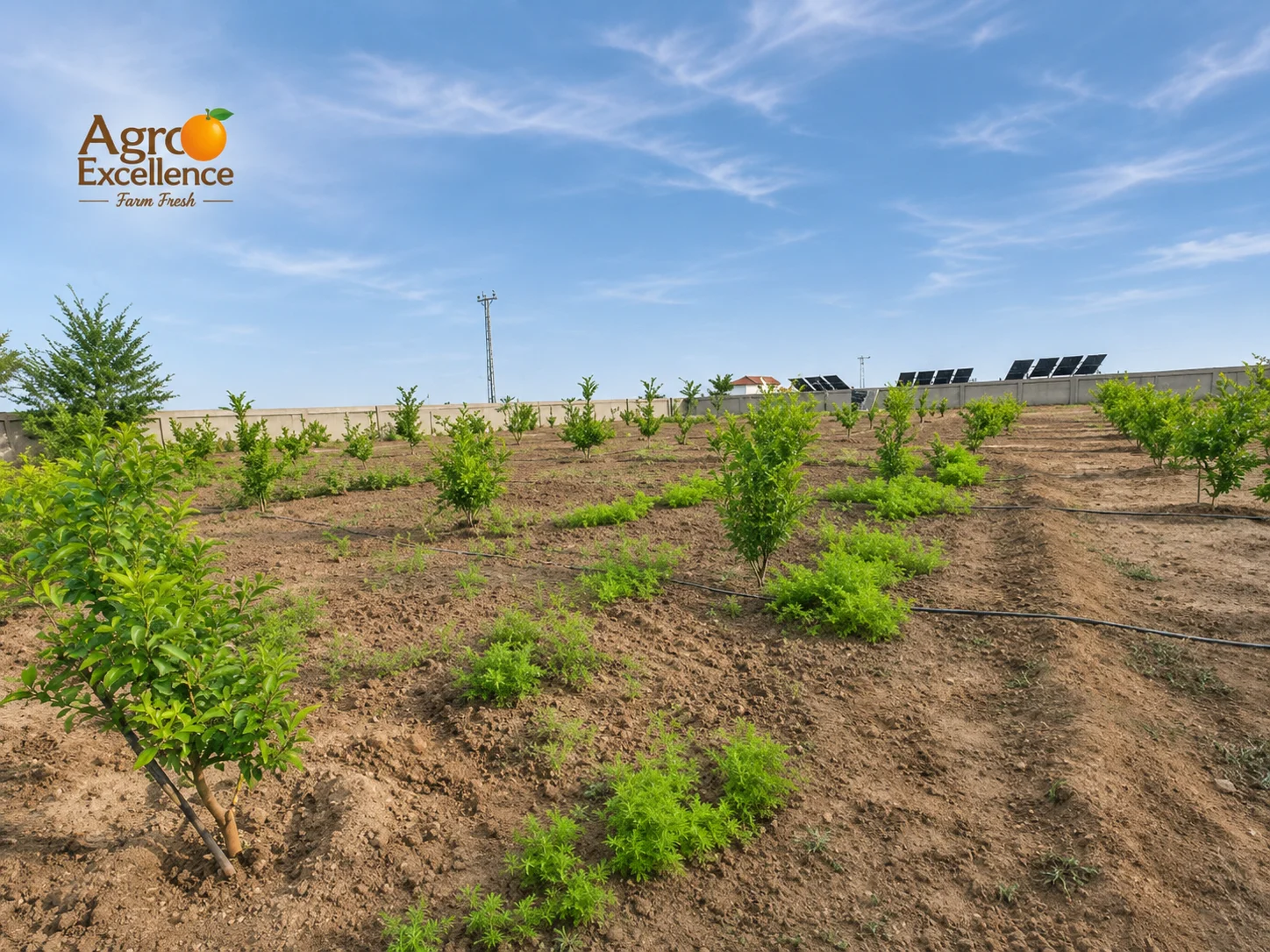
- Water security built in: each farmland is served by a dedicated solar-powered tube well, plus River Tarap irrigation – dependable water for year-round food production.
- Fertile, productive land: the Talagang region grows wheat, pulses, groundnut, vegetables, and orchard fruit — real, varied food for your family.
- Managed and secure: as a gated, master-planned community with on-ground management, your land is cultivated and protected even when you are in the city.
- Close to home: about 75 minutes from Islamabad, so you can stay connected to your land without leaving your job or city life.
- A productive asset: land that feeds your family today and appreciates in value for tomorrow – strengthening Pakistan’s wider food security one family at a time.
Own the Source, Not Just the Shopping List
Food inflation is not a phase – it is the new permanent reality. Every year, the market will ask your family for more money and give you less food in return. You can keep running that race and keep falling behind, or you can step off it entirely by owning the source of your food rather than only its ever-rising price tag.
Growing your own food is no longer a lifestyle choice for the few – it is the most practical financial and family-security decision available to ordinary Pakistanis. The families who secure productive land now, while it is still affordable, are the ones who will eat well, worry less, and stay independent as food prices climb for everyone else. In an economy where everything gets more expensive, the land that feeds you is the one investment that pays you back at every meal.