Farmland vs Gold: Which Is the Better Inflation Hedge in Pakistan in 2026/27?
Pakistan’s inflation rate stands at 11.15% in August 2026, compared with 9.2% in July. It means the prices of many goods and services increase over time. When prices rise, the value of money also decreases. People who keep their savings in cash may find that their money buys less than before. This is why many Pakistani investors consider gold and property as ways to protect their savings from rising prices.
Gold is a popular choice in Pakistan because it is easy to buy and sell and has a long history of holding value. Farmland offers a different option because it can increase in value while also providing opportunities to earn from agricultural activities. This makes the way farmland is selected, developed and managed an important part of any investment decision. Agro Excellence Farms follows this approach by focusing on farmland where the land remains an asset while agricultural activities add to its long-term value.
Gold vs Farmland: The Smarter Investment
Gold and farmland are both real assets, but they create value in very different ways. Gold mainly protects wealth through price appreciation. Productive farmland can potentially benefit from land appreciation while also creating income through crops, livestock, leasing or other agricultural activities.
For investors in Pakistan, this distinction matters. Inflation can reduce the purchasing power of cash, but the performance of gold and farmland depends on different economic factors.
1. Price Trends of Gold in Pakistan
Gold has traditionally been viewed as a store of value during periods of inflation, currency weakness and economic uncertainty. Its value in Pakistan is influenced by two major factors: the international gold price and the value of the Pakistani rupee against the US dollar. This means local gold prices can rise even when international prices move slowly if the rupee depreciates.
Research from the Pakistan Institute of Development Economics found evidence that gold acted as an effective inflation hedge in Pakistan during the period examined from 2001 to 2013. Another PIDE study found that gold also provided protection against exchange-rate risk and acted as a safe-haven asset during periods of financial stress.
2. Value Trends of Farmland in Pakistan
Farmland follows a different pricing pattern. There is no single nationwide farmland price index in Pakistan that can be used like the daily gold rate. Agricultural land values vary considerably between districts and even between nearby locations.
The value of farmland can be affected by:
- availability of irrigation water
- soil quality and agricultural productivity
- road and motorway access
- distance from major cities and markets
- nearby infrastructure development
- legal title and possession
- demand for agricultural production
- future development potential
A long-term study of irrigated and rain-fed areas finds that better farming methods can increase the income earned from farmland. As the income from farming increases, the value of the land can also rise. This shows that the value of farmland does not depend only on its market price. Its ability to produce income also matters.
This is what makes productive farmland different from land bought only for speculation. When land is used for farming, it can offer both the potential for land value growth and income from agricultural activities. Agro Excellence Farms follows this productive farmland approach, where agricultural use remains an important part of the value that the land can offer over the long term.
3. ROI: Gold vs Farmland
A direct ROI comparison requires caution because gold and farmland generate returns differently.
Gold:
Gold normally does not produce regular income. The investor earns when the market value of the gold increases. Its return therefore depends largely on the purchase price, future gold prices and movements in the Pakistani rupee.
Farmland:
Farmland can potentially produce two forms of return:
1. Capital appreciation if the market value of the land increases over time.
2. Agricultural income through crops, orchards, livestock, contract farming or leasing.
This income component is one of the biggest differences between farmland and gold. However, farmland income is not automatic. Returns depend on crop selection, water availability, farm management, input costs, yields and market prices.
The performance of farmland can vary from one location to another. Land with good water access, road connectivity and farming potential can perform very differently from undeveloped land with limited access or water. This is why choosing the right farmland matters when you plan to invest for the long term. Investors need to look beyond the land price and consider its location, water availability, access and agricultural potential. Our farms are developed with productive agricultural use in mind, giving investors an opportunity to consider farmland not only as land ownership but also as a long-term productive asset.
4. Gold vs Farmland: Risk and Volatility
Gold vs Productive Farmland
| Factor | Gold | Productive Farmland |
|---|---|---|
| Price Volatility | Can change quickly | Usually changes more gradually |
| Liquidity | High | Lower |
| Regular Income | Usually none | Possible through farming or leasing |
| Management Required | Low | Moderate to high |
| Location Risk | None | Depends heavily on location |
| Currency Sensitivity | High | Mostly indirect |
| Legal Due Diligence | Relatively simple | Very important before purchase |
| Physical Utility | Limited | Can be used for productive agriculture |
| Investment Horizon | Suitable for short- and long-term holding | Better suited to long-term ownership |
5.Which Is the Better Inflation Hedge?
Gold can protect money during inflation, but productive farmland can offer more long-term value. Farmland is limited, useful and can earn income through crops, livestock or leasing. Its value may also rise when demand for land and food increases. For long-term investors, productive farmland can be a strong option because it can provide both income and possible land appreciation.
This creates a dual-value structure:
Farmland value = potential land appreciation + potential agricultural income
Gold mainly depends on:
Best Investment Choice Based on Investor Needs
| Investor Need | Best Choice | Why |
|---|---|---|
| Long-term wealth building (5+ years) | Farmland | Combines appreciation with ongoing crop or livestock income |
| Passing wealth to the next generation | Farmland | A tangible, usable asset that also keeps appreciating |
| Protection against rising food and construction costs | Farmland | Land and crop income both move with these costs directly |
| Immediate cash within days | Gold | Faster to liquidate through a local jeweller |
| A small, quick crisis reserve | Gold | Can be bought and sold in small amounts |
| A balanced approach | Both | Gold for short-term liquidity, farmland for long-term growth and income |
What Makes Farmland a Stronger Long-Term Asset in Pakistan?
The strongest farmland is not simply land labelled as agricultural. Its long-term value comes from a combination of productive and location factors.
- Clear legal ownership: Computerized land records and a verifiable title reduce one of the biggest risks in Pakistani property transactions.
- Reliable irrigation: Water availability directly affects what can be grown and how consistently the land can produce.
- Soil quality: Fertility and the ability to improve soil influence crop choices, yields and farm economics.
- Road and market access: Better access lowers transport friction and connects produce with buyers.
- Useful farm size and layout: A workable layout makes mechanization, crop rotation, orchards and irrigation easier to plan.
- Professional management: Productive land needs crop selection, procurement, labour, cultivation and monitoring. Management quality affects net income.
- Long-term location potential: Infrastructure and access to growing urban markets can influence land demand over time.
Why Agro Excellence Farms Strengthens the Case for Farmland
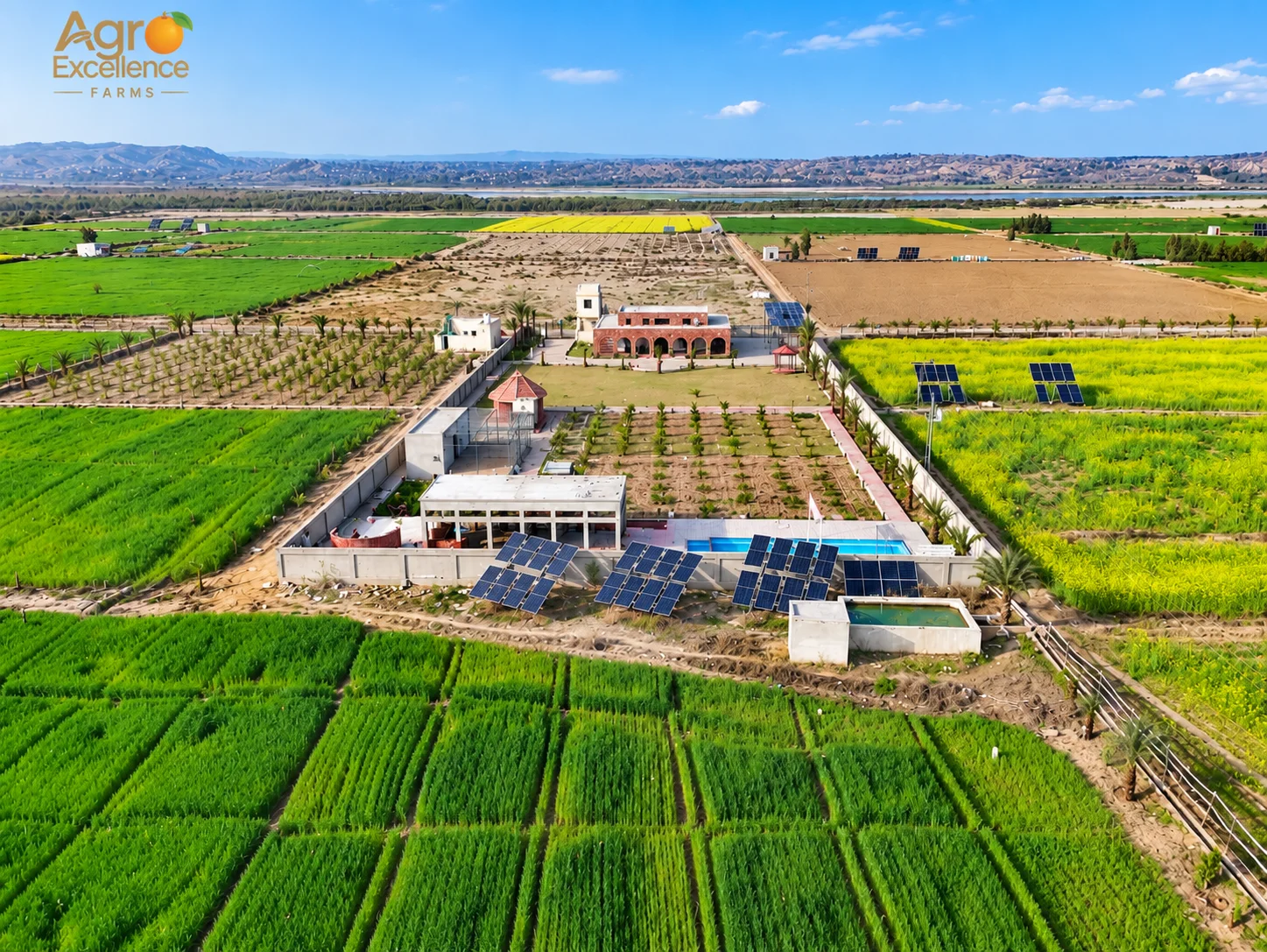
Gold can help protect wealth during inflation, but it mainly depends on future price increases. Productive farmland can offer another advantage: the land can be used to generate agricultural income while its long-term value may also grow. This is where Agro Excellence Farms fits into the farmland vs gold comparison. We offer 40 and 48 Kanal farmland near the Tarap Interchange on the CPEC Western Route with land planned for crops, orchards, vegetables and other agricultural uses.
Instead of holding land that remains unused, you can explore farmland design and land-use planning and use available farm development and management services for cultivation, irrigation, machinery and farm support. We provide solar water and irrigation systems which can support productive farming. For investors comparing gold with long-term agricultural land, this productive use is important. You can also explore the future of farmland investment to understand how farmland can combine ownership with practical agricultural value.
Challenges in Tunnel Farming
Tunnel farming can offer strong returns, but growers may face several practical challenges:
- High initial investment: Tunnel structures, certified seeds, irrigation systems, and other inputs can cost more than conventional open-field farming.
- Limited access to certified inputs: Farmers may struggle to find reliable certified seeds, fertilisers, and other quality inputs when needed.
- Lack of technical knowledge: New growers often need proper guidance on tunnel management, crop selection, irrigation, pest control, and temperature management.
- Limited cold storage facilities: Without nearby cold storage, vegetables can lose quality quickly, especially during peak harvesting periods.
- Higher transportation costs: Farmers located away from major markets may spend more on transporting produce to cities and wholesale markets.
- Weak market access: High yields do not always guarantee high profits. Growers may receive lower prices if they do not have direct access to reliable buyers or profitable markets.
- Limited access to finance: Smaller and new growers may find it difficult to arrange funding for tunnel installation, seeds, fertilizers, and other operating expenses.
- Uncertain seed and fertilizer supply: Delays or shortages in important inputs can affect planting schedules and overall crop performance.
- Need for professional support: Farmers generally achieve better results when they have access to experienced agricultural guidance throughout the growing season. Working with agricultural partners such as Agro Excellence Farms can help growers make better-informed decisions about tunnel setup, crop planning, input management, and overall farm performance.
Frequently Asked Questions
Farmland can be better for long-term investors who want productive use and possible income. Gold is generally better for liquidity and short-term flexibility. The stronger option depends on the investor’s time horizon, capital and risk tolerance.
Pakistan-specific PIDE research found gold to be an effective inflation hedge over its study period. Gold prices in Pakistan are also influenced by international bullion prices and the PKR exchange rate.
It can. Productive farmland may generate income through crops, vegetables, orchards, livestock activities or leasing. Actual net income depends on water, crop selection, input costs, yields, market prices and management.
No. Land prices are location-specific. Research in Pakistan shows that productivity, irrigation, market access, roads and expected capital gains can influence agricultural land prices. Inflation alone does not guarantee appreciation.
Gold is usually much easier to sell. Farmland transactions can take longer because the buyer must assess location, title, access, water and the price of the full land parcel.
Verify ownership and land records, confirm access and boundaries, assess irrigation and water quality, review soil suitability, compare nearby land values and build a realistic farming or leasing plan. Legal and tax advice may also be appropriate for larger transactions.
It may help preserve purchasing power if local land values and farm income rise over time, but the relationship is not guaranteed. Gold has a more direct link to global prices and the rupee-dollar exchange rate, while farmland depends more on local productivity and demand.