Organic vs. Conventional Farming in Pakistan: A 2026 Profit Comparison with Real Case Studies
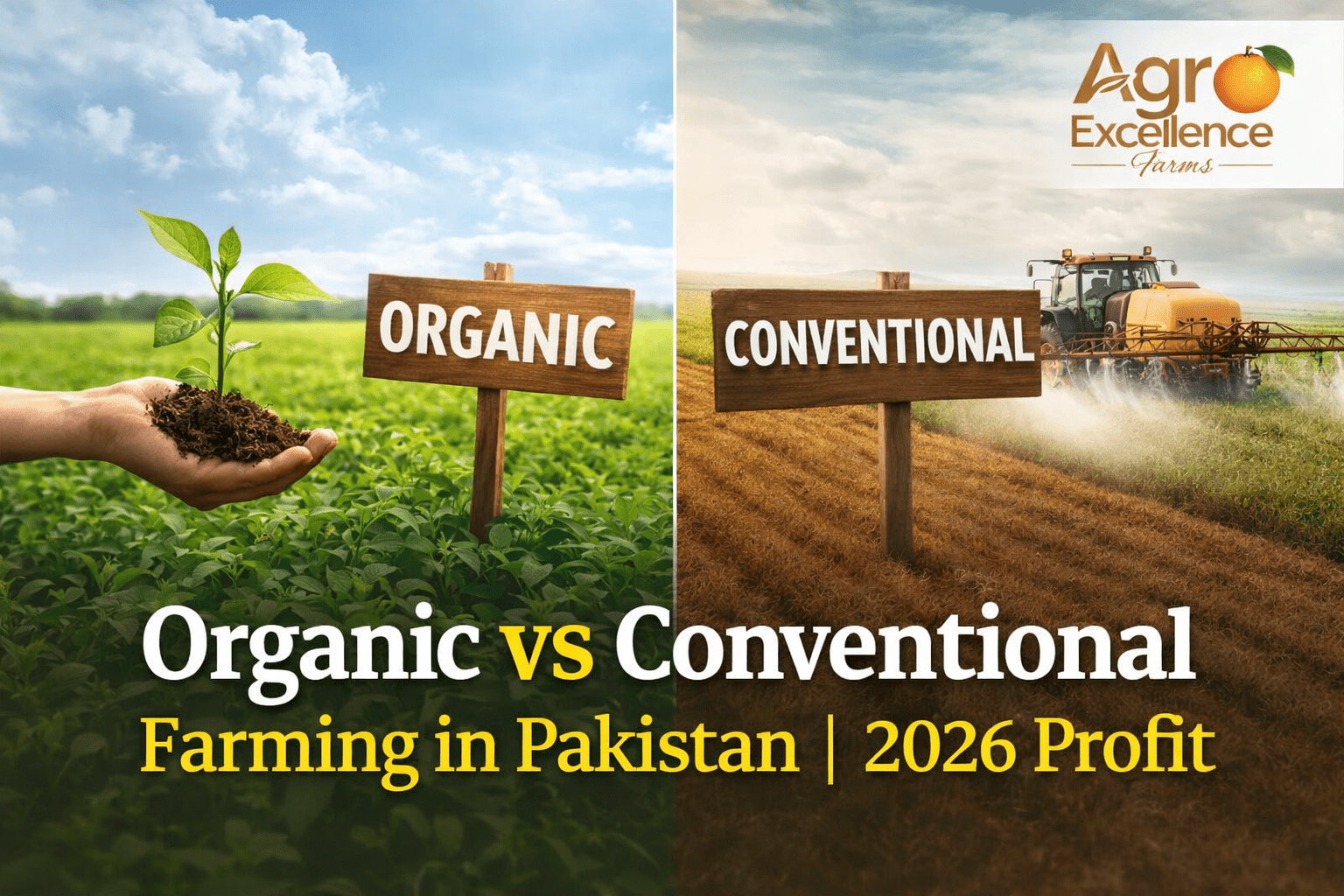
There is one question that almost every Pakistani farmer considering a shift to organic practices eventually asks: does organic farming actually pay more? The answer is not as simple as a yes or no it depends on the crop, the market access, the certification status, and the time horizon you are measuring. But in 2026, with rising input costs squeezing conventional farming margins and international organic markets offering 25–30% price premiums, the numbers are increasingly tilting in favour of organic.
Pakistan uses 4.2 million tons of synthetic fertilizers annually, and conventional farming allocates 35–40% of its total production cost to synthetic fertilizers and pesticides alone. As global fertilizer prices remain volatile and soil health continues to degrade on chemically farmed land, the long-term economics of conventional farming in Pakistan are under serious pressure.
Organic vs. Conventional Farming in Pakistan: The Numbers Side by Side
Here is how organic and conventional farming compare across key performance indicators based on field research conducted across three districts of central Punjab, Pakistan:
| Factor | Organic Farming | Conventional Farming | Winner |
| Input Cost (per acre) | PKR 18,000–25,000 | PKR 32,000–48,000 | Organic ✓ |
| Wheat Yield (per hectare) | ~3,518 KG | ~4,299 KG | Conventional ✓ |
| Farm-Gate Price Premium | 25–30% higher | Standard rate | Organic ✓ |
| Net Profit (3-yr avg) | Equal or higher | Higher short-term | Organic (long-term) ✓ |
| Soil Health (5 yrs) | Improves steadily | Degrades over time | Organic ✓ |
| Export Market Access | Full access (certified) | Limited (standard) | Organic ✓ |
| Climate Resilience | Higher | Lower | Organic ✓ |
Research from 444 farms across Punjab found that organic wheat input costs were 20% lower per hectare compared to conventional wheat. For organic rice, input costs were 10% lower than conventional. Although conventional farms produced higher raw yields conventional wheat averaged 4,299 kg per hectare versus 3,518 kg per hectare for organic the organic price premium and lower input costs resulted in comparable or better net profitability per acre.
The Input Cost Reality: Where Organic Wins on Expenses
This is the most underappreciated advantage of organic farming for Pakistani farmers. Conventional wheat cultivation in Pakistan spends 35–40% of its total budget on synthetic fertilizers and pesticides. As global urea prices fluctuate sharply and Pakistan remains heavily dependent on fertilizer imports every price spike directly eats into conventional farmer margins. Organic farmers, by contrast, rely on compost, poultry manure, green manuring, and crop rotation to maintain soil fertility. These inputs are either produced on-farm or sourced locally at stable prices.
Organic wheat farmers in Punjab reported input costs between PKR 18,000 and PKR 25,000 per acre, compared to PKR 32,000 to PKR 48,000 for conventional farmers in similar growing conditions. Over a three-to-five year period, as soil health improves under organic management, input requirements often decrease further — creating a compounding cost advantage.
Case Study 1: Organic Rice Farmer in Sheikhupura, Punjab
A rice farmer in Sheikhupura district, central Punjab, completed his 3-year organic transition in 2022. In his first certified organic season, his per-hectare yield dropped from an average of 2.8 tons to 2.1 tons a 25% reduction in volume. However, he secured a purchase contract with an organic export company at a price 30% above the standard market rate for basmati rice. His net profit per acre in year one of certified organic farming exceeded his conventional farming profit from the previous three years by 18%. By year two, as his soil health improved and input requirements decreased, his margin expanded further. Today, he farms 22 acres entirely under organic management and exports directly to buyers in the UAE.
Case Study 2: Conventional Vegetable Farmer in Faisalabad — The Other Side
Not every story favours organic farming, and it is important to be honest about this. A vegetable farmer in Faisalabad growing tomatoes and onions conventionally reported strong short-term income due to high yields and established market relationships with local wholesalers. His input costs were high approximately PKR 44,000 per acre but his yields were consistently 30–40% higher than organic benchmarks in his region. He operates in a high-volume, price-sensitive local market where organic premiums are not yet established. For this farmer, the transition to organic would require 2–3 years of lower income during the transition period, new market relationships, and certification costs a package of risks he has not yet found justified by current domestic organic price premiums.
This case highlights a critical truth: organic farming is most profitable when paired with certified status and access to premium markets — either export or urban specialty retail. Without these market connections, organic yields the environmental and soil benefits but not necessarily the income premium.
Case Study 3: Cooperative Transition in Talagang, Punjab
A farming cooperative near Talagang, located in Chakwal district, made a partial transition converting 40% of their land to organic sunflower and maize while maintaining conventional wheat on the remainder. This hybrid approach allowed the cooperative to maintain stable income during the organic transition period while building certification documentation and buyer relationships. After two seasons, the organic portion of their land was achieving profit margins 22% higher than the conventional portion, primarily due to lower input costs and a price agreement with an Islamabad-based organic processor. The cooperative is now expanding its organic acreage and expects full certification by mid-2026.
The Soil Economy: Why Conventional Farming Faces a Hidden Long-Term Cost
A 2023 report by the Pakistan Environmental Protection Agency found that chemical fertilizers have degraded 40% of the country’s arable land. Soil degradation is a direct threat to long-term farm income — degraded soil requires ever-increasing chemical inputs to maintain yields, creating a cost spiral that erodes conventional farm profitability over time. A University of Agriculture Faisalabad study found that organic farms in Punjab had 50% more earthworms and beneficial soil microbes compared to conventional farms. Healthier soil means better water retention, stronger natural pest resistance, and higher long-term yields — all of which translate directly to improved farm economics over a 5–10 year horizon.
The 2026 Market Verdict: Which Farming Method Wins?
In 2026, the profit comparison between organic and conventional farming in Pakistan depends heavily on three factors: market access, certification status, and time horizon. In the short term (1–3 years), conventional farming often delivers higher absolute yields and immediate market access. In the medium-to-long term (3–7+ years), certified organic farming with established export or premium domestic market connections consistently outperforms conventional farming in net profit per acre, input cost stability, and soil health resilience.
Pakistan’s agri-food exports grew 37% in FY24, and organic produce is the fastest-growing segment of this expansion. With conventional fertilizer costs remaining volatile and international organic market premiums remaining robust, 2026 is shaping up as one of the strongest arguments yet for Pakistani farmers to begin or accelerate their organic transition.
Which Path Is Right for You?
If you have access to certification support, premium market connections, and the financial capacity to navigate a 2–3 year transition period, organic farming in Pakistan is a financially compelling and strategically sound choice in 2026. If you are a smallholder without these supports yet, a phased approach converting part of your land while building market relationships is the smart starting point.
At Agro Excellence Farms, our farmland community in Talagang, Punjab is built around sustainable and organic farming principles with solar-powered irrigation, professional agronomic support, and a growing network of organic market connections. Whether you are an investor looking for premium farmland or an experienced farmer ready to scale up, we are building the infrastructure that makes organic farming in Pakistan genuinely profitable.
Ready to invest in farmland built for the future of Pakistani agriculture?
Visit agroexcellencefarms.com or call +92 311 111 AGRO. Explore 22, 40, and 48 Kanal farmland options in Talagang, Punjab.
Frequently Asked Questions (FAQs)
Is organic farming more profitable than conventional farming in Pakistan in 2026?
Yes, in most cases especially for farmers with organic certification and access to export or premium domestic markets. Organic input costs are 20–40% lower and the price premium adds 25–30% on top, making net profitability equal or higher despite slightly lower yields.
What is the biggest disadvantage of switching from conventional to organic farming in Pakistan?
The 2–3 year organic transition period is the hardest part. During this time, yields may dip slightly while certification costs apply, but the farm cannot yet sell as certified organic.
Which crops show the best profit improvement when switching to organic farming in Pakistan?
Basmati rice, turmeric, cumin, dried fruits, and sunflower show the strongest profit improvement under organic management in Pakistan, due to high international demand and significant price premiums available to certified organic producers.